Want a Free Quote?
Looking for a Solar System or related products?
Complete our quote form below and we will get back to you as soon as we can:

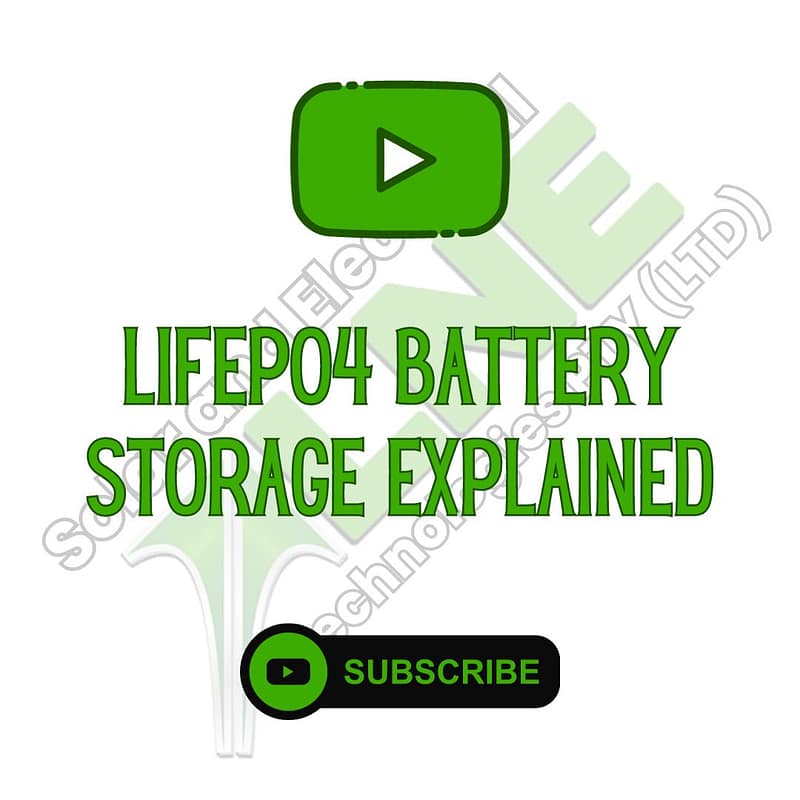
Warranty conditions:
Each battery manufacturer has their own conditions regarding the installation and use of their modules. Please follow the manufacturer installation manual and specification to comply with their own specific conditions. On the right-hand side find indicative state of charge settings which may influence the general operation of the available storage capacity. Most lithium-ion battery manufacturers suggest settings to shut down the inverter output when the state of charge reaches 10% or below.
We recommend inverter output shutdown setting at 20% and below. This can thus increase the lifespan of a lithium battery. This also ensures enough power to keep the inverter active during long power outages. Usually, the low alarm can be set to sound a warning when the state of charge falls below 30% on the inverter.
With a shutdown value at 20% SOC a fully charged battery will have 80% usable power available of its rated capacity. (For example: a 5-kWh battery will have only 4kWh of Power available before the inverter output is disabled)
After inverter output shutdown system will only restart after a charging Source becomes available. Additionally the Battery SOC must also reaches the preset “restart” value. A fully compatible communication between the battery management system and the inverter is recommended. This is for optimal system control and operation.
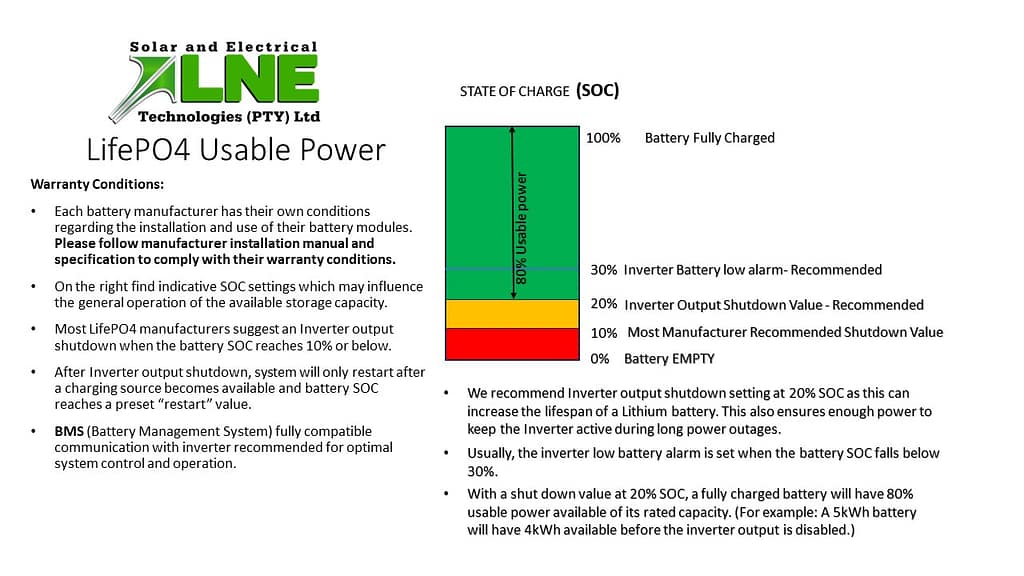
The maximum charge or discharge power which it can handle at any given moment, is the C rating multiplication with its rated power.
For example:
A 5 kWh battery at C 0.5 is; 5-kWh multiply with 0.5 C thus the maximum charge or discharge power at any given moment is 2.50kWh. Exceeding this value will cause the unit to shut down due to overloading. A 0.5 C rating module can only deliver half of its power at any given moment.