Please take note of our Closing and Reopening Dates for this Festive Season from 20 December 2025 – 10 January 2026

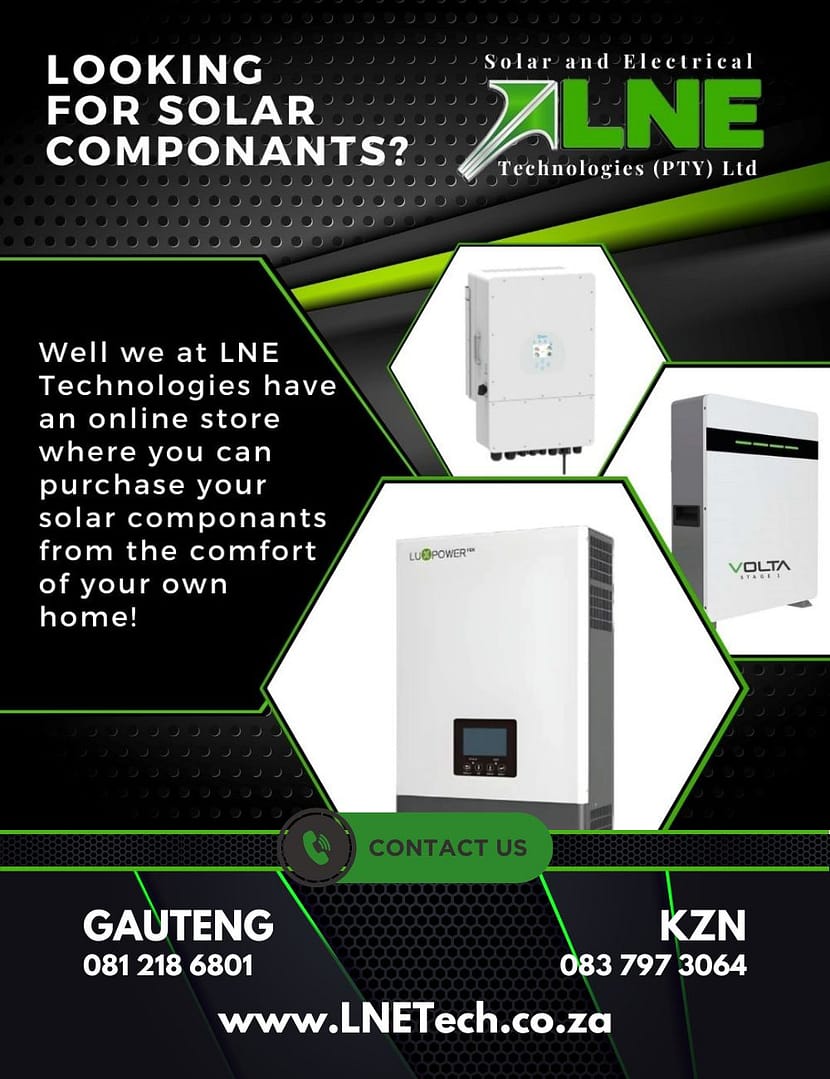
Looking for Solar Components?

Solar energy systems are comprised of various components that work together to convert sunlight into usable electricity. The main components of a solar energy system include solar panels, inverters, batteries, and charge controllers.

Solar panels, also known as photovoltaic (PV) panels, are the most recognizable component of a solar energy system. They are made up of multiple solar cells that convert sunlight into direct current (DC) electricity. These panels come in various sizes and types, with the most common being monocrystalline and polycrystalline panels. Monocrystalline panels are more efficient and expensive, while polycrystalline panels are more affordable but less efficient.

Inverters are another important component of a solar energy system

They convert the DC electricity produced by the solar panels into alternating current (AC) electricity that can be used to power household appliances and electronics. There are two types of inverters: central inverters and microinverters. Central inverters are connected to multiple solar panels, while microinverters are attached to each individual solar panel. Microinverters are more efficient but also more expensive.

Batteries are optional components that can be added to a solar energy system to store excess electricity generated by the solar panels. This stored energy can be used during times when there is little or no sunlight, such as at night or on cloudy days. The most common type of battery used in solar energy systems is the lead-acid battery. However, newer and more advanced options, such as lithium-ion batteries, are becoming more popular due to their higher efficiency and longer lifespan.

Charge controllers are used to regulate the amount of electricity

The regulate the amount of electricity that flows from the solar panels to the batteries. They prevent overcharging and extend the lifespan of the batteries. There are two types of charge controllers: PWM (pulse width modulation) and MPPT (maximum power point tracking). MPPT charge controllers are more efficient and expensive than PWM controllers.

Overall, these components work together to create a sustainable and renewable source of energy that can save money and reduce carbon emissions. As technology advances, these components will continue to improve, making solar energy systems even more accessible and efficient for households and businesses alike.

To find out more or to simply inquire about a professional solar system then please contact LNE Solutions today:

Want a Free Quote?

Looking for a Solar System or related products?
Complete our quote form below and we will get back to you as soon as we can:

Want a Free Quote?

Looking for a Solar System or related products?
Complete our quote form below and we will get back to you as soon as we can:

Residential
Rent to Own

Coming Soon In 2024